 English
 Español

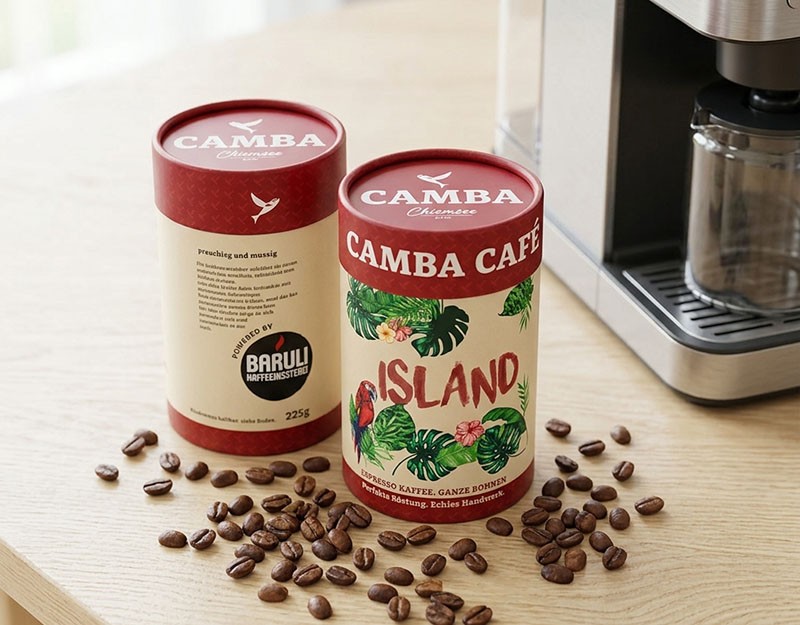
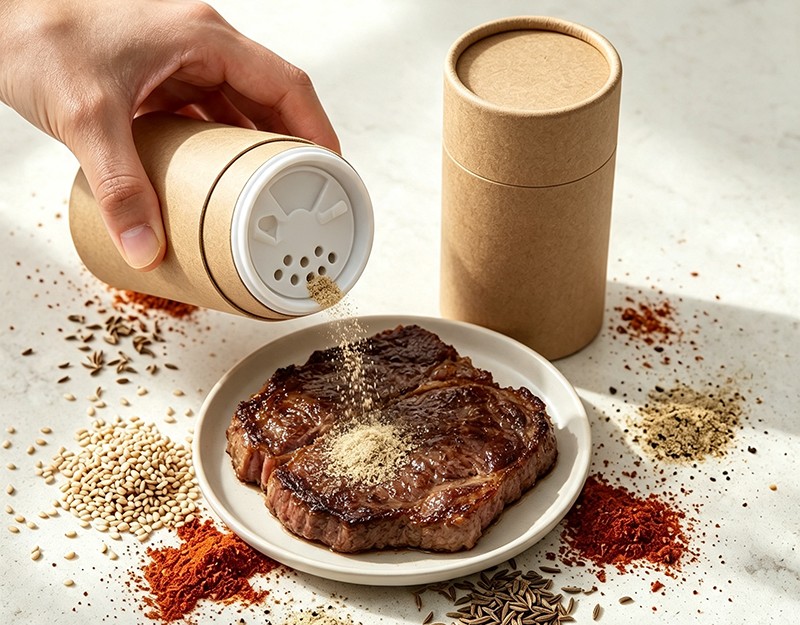

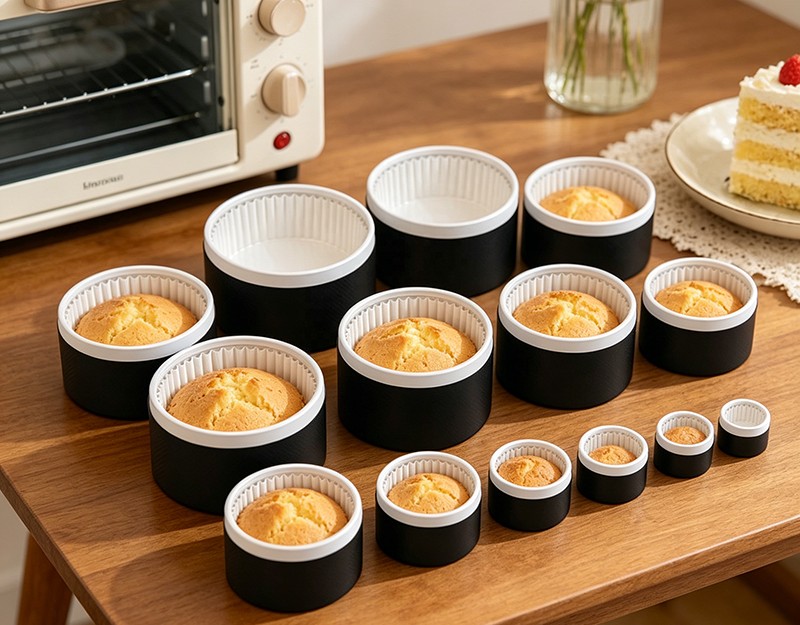
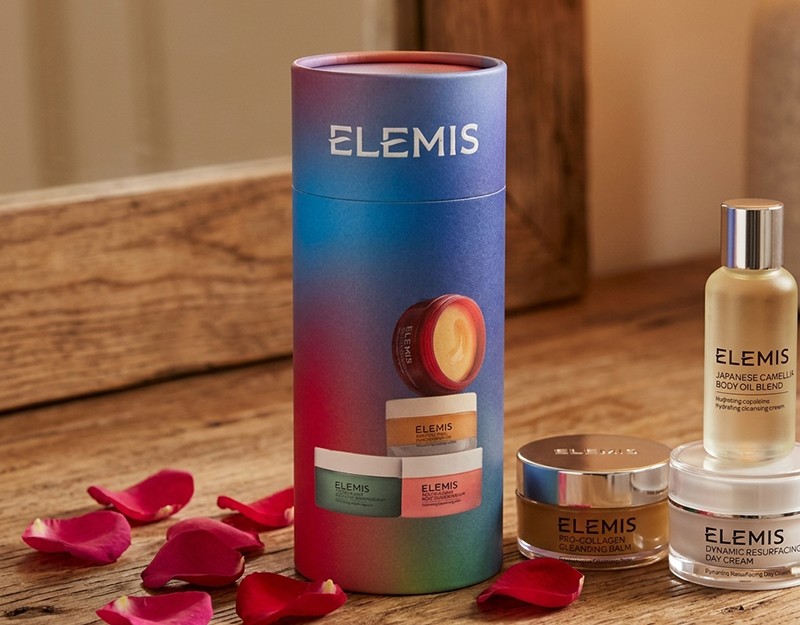
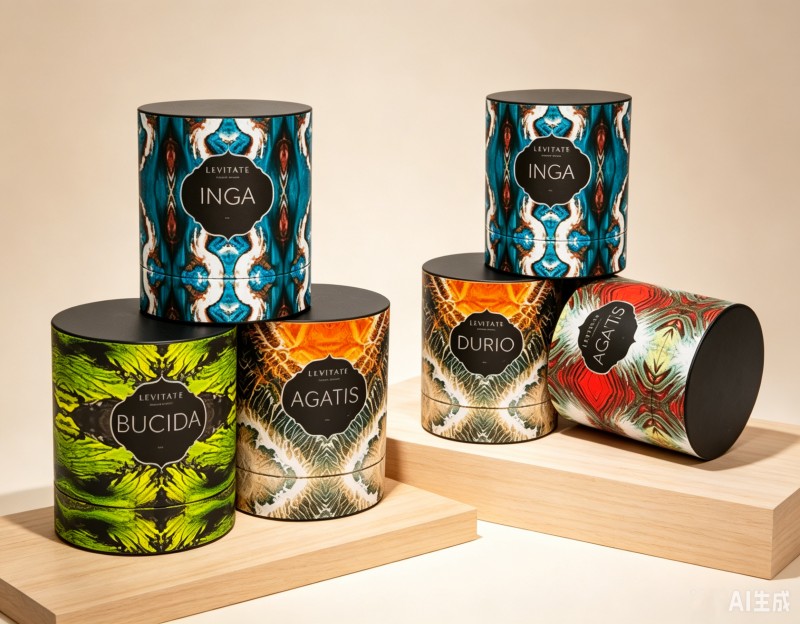
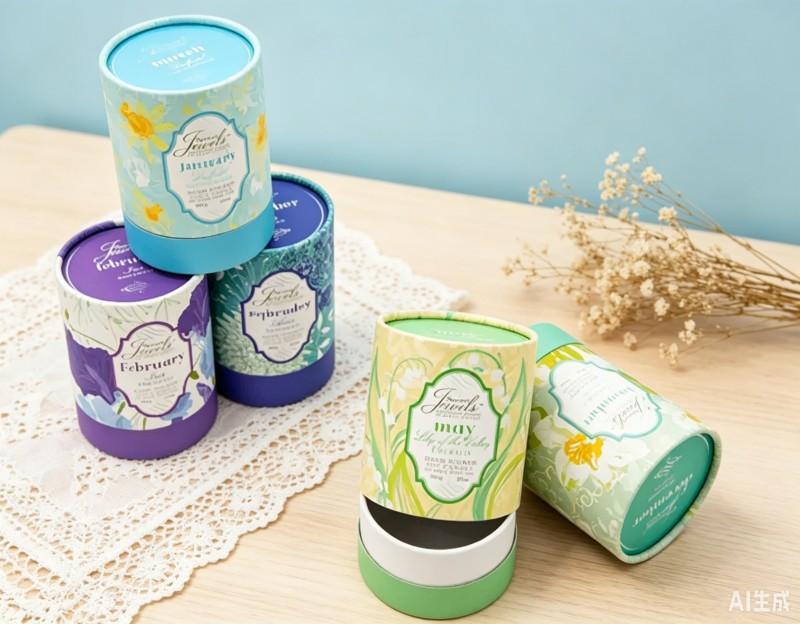
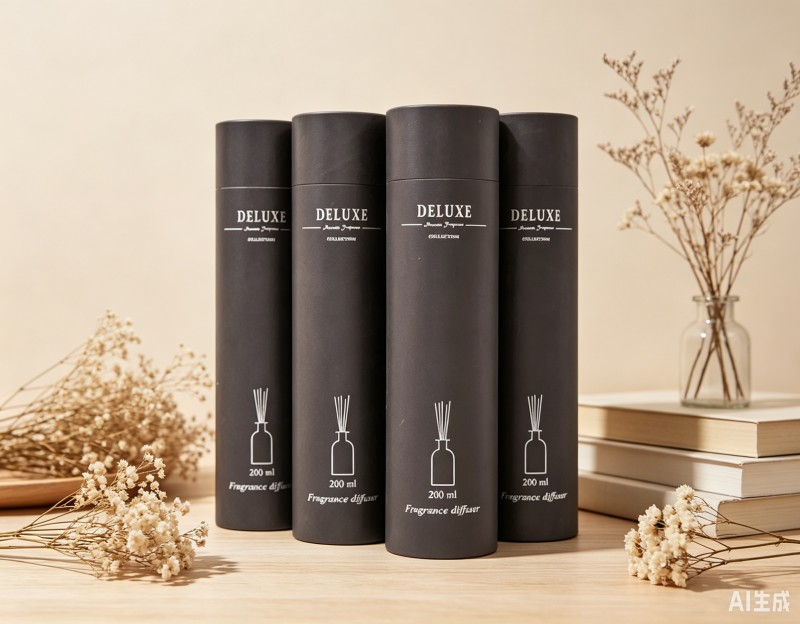
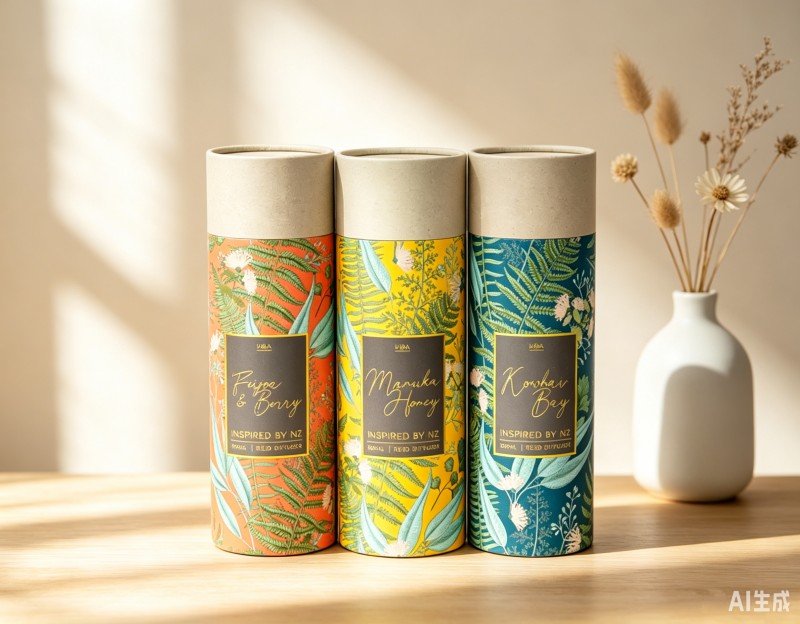
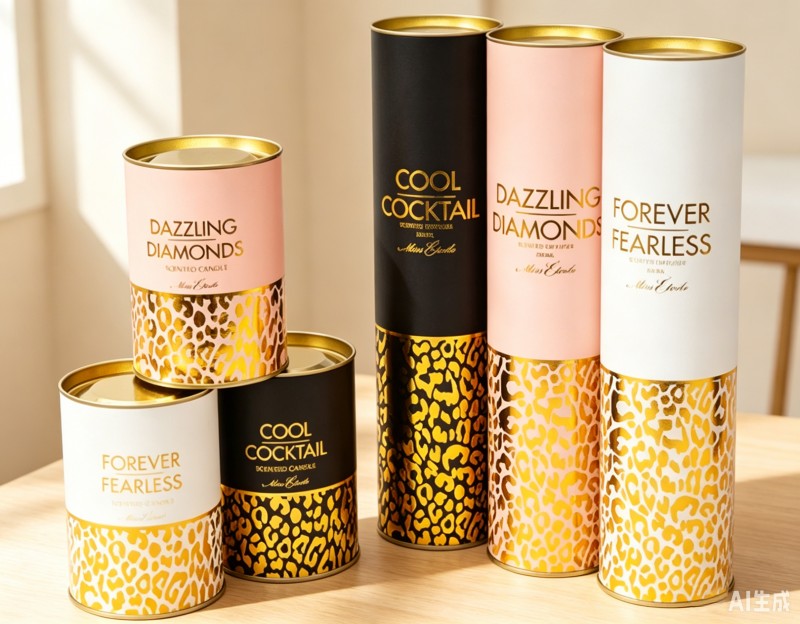
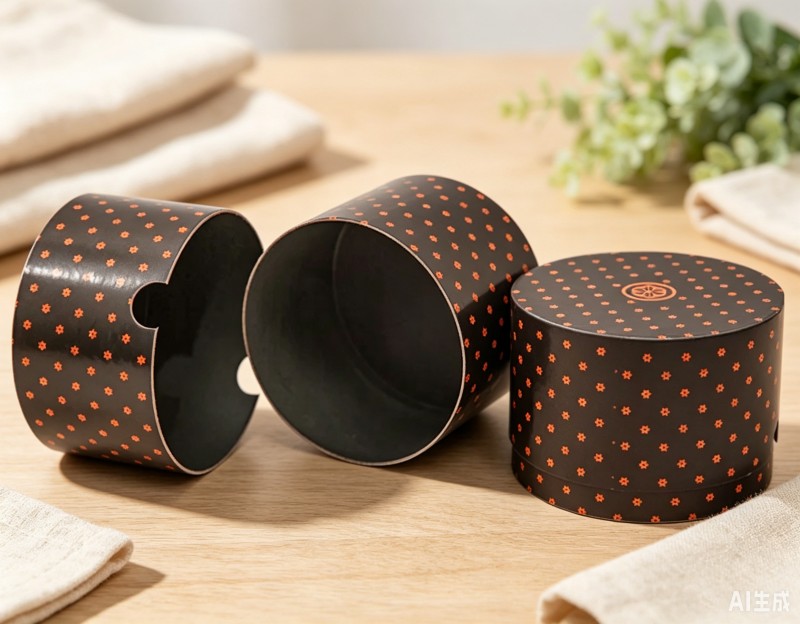
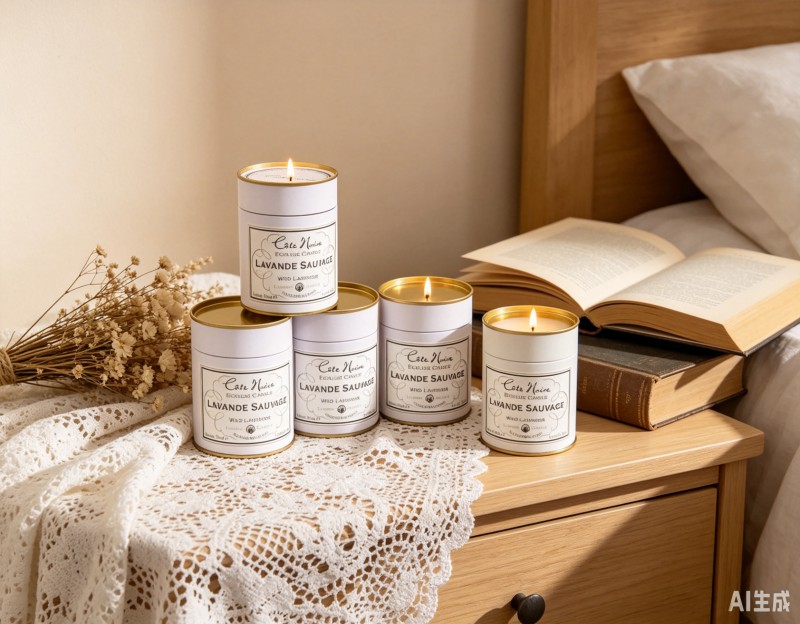

As one of the top China cardboard tube packaging manufacturers and paper tube packaging suppliers, we devote all of our efforts to research and launch more high quality packaging products to global market.
Packaging is often the first physical point of contact between a chocolate brand and its customer. Before a consumer tastes a product, the package communicates quality, freshness, creativity, and brand identity. For chocolate bars and candy products, packaging must do more than provide an attractive exterior. It must protect the contents, support efficient handling, create a memorable presentation, and meet the practical requirements of modern food packaging. Custom cylindrical paper tube packaging with a tin plug offers a balanced solution for brands seeking a distinctive and responsible alternative to conventional boxes, plastic containers, and standard paper wrappers.
This custom packaging solution combines an all-paper cylindrical body with a carefully designed closure system and a printed outer surface. It is designed specifically for chocolate bar packaging and related confectionery products. The cylindrical format gives the package a recognizable appearance, while the customizable dimensions, CMYK printing, art paper labeling, and tin plug allow businesses to develop packaging that reflects their product positioning. The listed model uses an internal diameter of 73 millimeters and a height of 170 millimeters, although customized sizes can be considered for different products and brand requirements.
Manufactured by Hangzhou Qunle Packaging Co., Ltd., the product is supported by more than two decades of experience in composite cans and paper cans. The company serves food, daily chemical, fast-moving consumer goods, and other packaging sectors. Its background in paper-based container production, food packaging certification, patented technologies, modern European production equipment, and long-term cooperation with recognized brands gives customers access to an experienced manufacturing partner rather than simply a printed packaging supplier.
This article examines the structure, performance, customization options, sustainability benefits, manufacturing capabilities, quality considerations, and commercial applications of cylindrical paper tube packaging for chocolate and candy bars. It also explains why this type of packaging can offer important advantages over competing formats when appearance, protection, brand differentiation, and responsible material selection are all important.
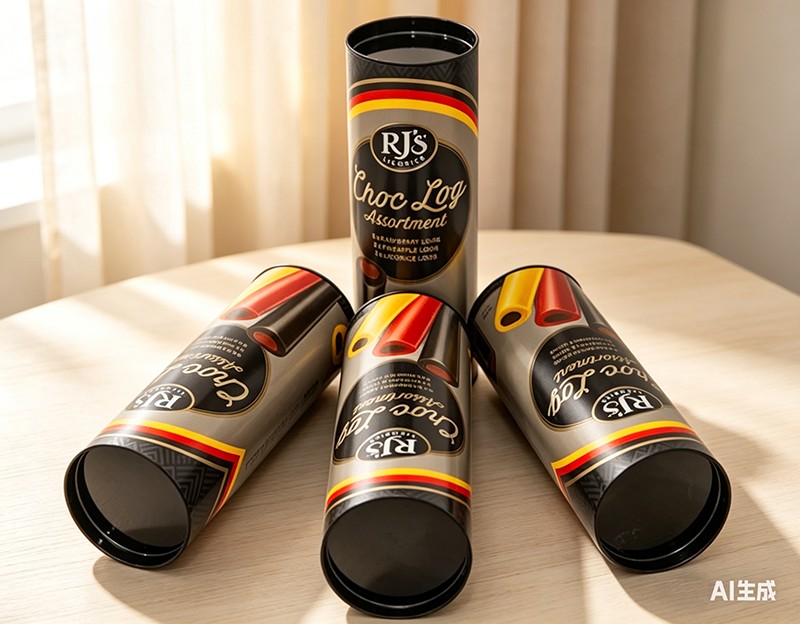
Custom Eco-friendly Cylindrical Paper Tube Packaging with Tin Plug for Chocolate Candy Bars
Content
- 1 What Is Cylindrical Paper Tube Packaging?
- 2 Core Product Specifications
- 3 Why the Cylindrical Format Is Valuable for Chocolate Products
- 4 Material and Structural Advantages
- 5 Printing and Surface Customization
- 6 Comparison with Common Competing Formats
- 7 Food Packaging Considerations
- 8 Manufacturing Expertise Behind the Product
- 9 Manufacturing Process for a Custom Chocolate Paper Tube
- 10 Quality Control Priorities
- 11 Sustainability Benefits and Responsible Use
- 12 Applications Beyond Standard Chocolate Bars
- 13 Branding Opportunities for Chocolate Manufacturers
- 14 Advantages of Working with an Experienced Factory
- 15 How to Develop a Successful Custom Tube Project
- 16 Commercial Benefits for Different Types of Brands
- 17 Limitations and Points Requiring Attention
- 18 Q&A: Custom Cylindrical Paper Tube Packaging
- 18.1 What products can be packed in this tube?
- 18.2 What is the reference size?
- 18.3 Is the packaging made from paper?
- 18.4 Can the artwork be customized?
- 18.5 Is the tin plug reusable?
- 18.6 Does the tube protect chocolate from heat and moisture?
- 18.7 Can the package be used for premium chocolate gifts?
- 18.8 What printing method is specified?
- 18.9 What should be provided when requesting a quotation?
- 18.10 Why choose a specialized paper tube manufacturer?
- 18.11 Can one tube design support multiple flavors?
- 18.12 Is cylindrical packaging suitable for e-commerce?
- 18.13 Can the tube be reused after the chocolate is finished?
- 19 Conclusion
- 20 References
- 21 Product: Custom Eco-friendly Cylindrical Paper Tube Packaging with Tin Plug for Chocolate Candy Bars
What Is Cylindrical Paper Tube Packaging?
Cylindrical paper tube packaging is a rigid or semi-rigid paper-based container formed into a round tube. Unlike a flat folding carton, the tube has a three-dimensional body that provides a strong visual presence and a stable structure. It may be produced with a paper body, printed paper label, paperboard layers, and a closure made from paper, metal, or a combination of materials. In the featured product, the main container is described as an all-paper material structure with an art paper label and a tin plug.
The cylindrical body is suitable for products that benefit from a premium presentation or require additional dimensional protection. Chocolate bars, candy bars, truffles, cookies, confectionery assortments, and other dry foods can be placed inside a tube when the internal dimensions and protective specifications are properly matched to the product. The format is also suitable for gift-oriented products, seasonal collections, promotional editions, and limited releases.
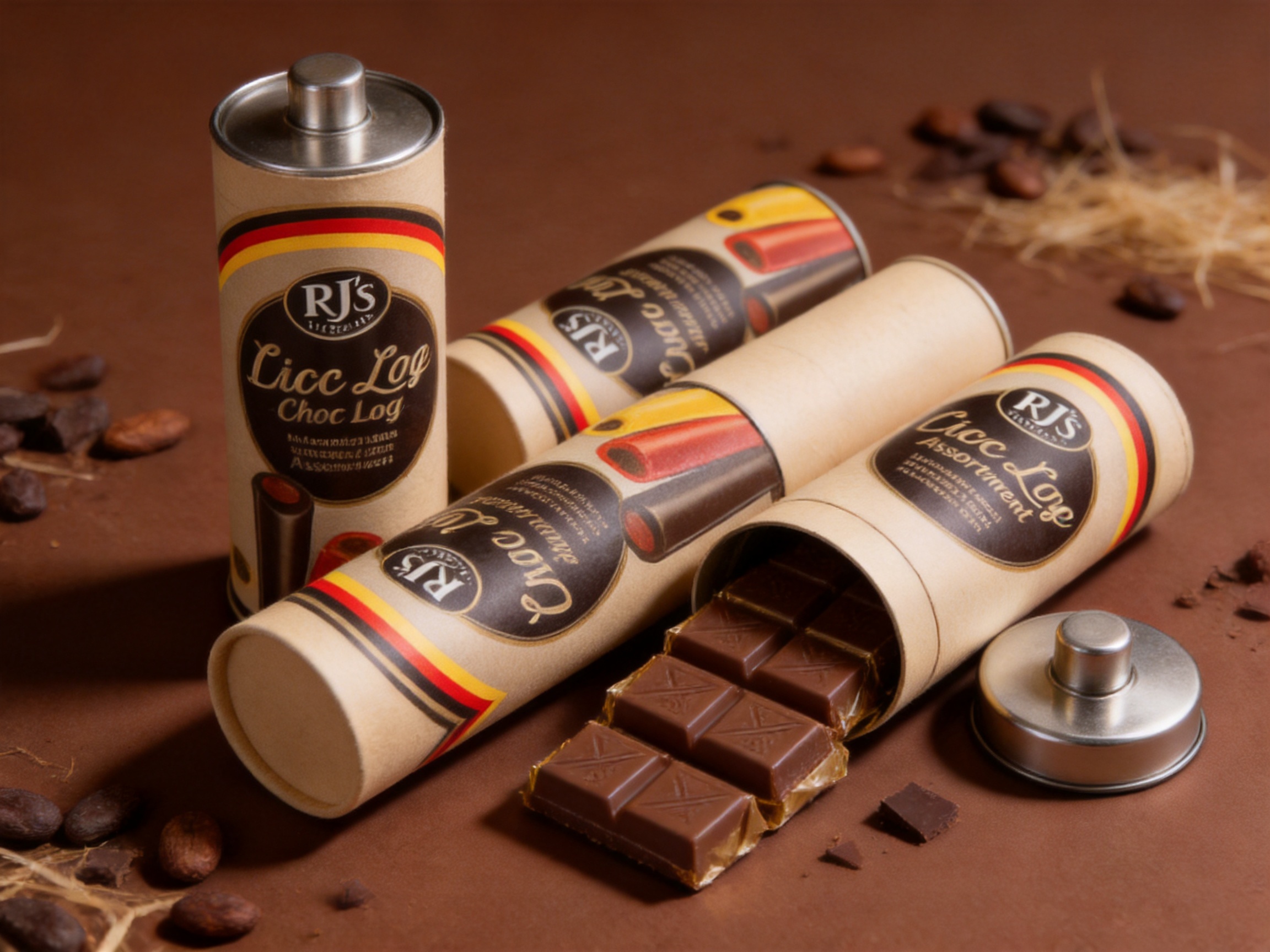
The shape creates a different consumer experience from a rectangular carton. A cylinder can stand upright on a retail shelf, lie horizontally in a display, or be arranged in a group to create a visually varied merchandising presentation. Its rounded profile can also make the product easier to recognize from multiple viewing angles. Because the outer surface wraps around the entire container, it provides a continuous area for brand colors, product illustrations, ingredient information, storytelling, and decorative graphics.
For chocolate brands, this presentation can be especially valuable. Chocolate is frequently purchased as a gift, an indulgence, a seasonal treat, or a premium everyday product. A tube can support these positioning strategies by giving the product a more substantial appearance than a simple flexible wrapper. It can also be retained by consumers for storage or secondary use, extending the package’s practical life beyond the initial purchase.
Core Product Specifications
The featured paper tube is a customized cylindrical package developed for chocolate bars and candy bars. Its listed specifications provide a practical starting point for brands that need a compact, attractive, and customizable container.
| Specification | Details |
|---|---|
| Product type | Custom cylindrical paper tube packaging |
| Primary application | Chocolate bar and candy bar packaging |
| Material structure | All-paper container with art paper label |
| Closure | Tin plug |
| Shape | Cylindrical |
| Reference size | Internal diameter 73 millimeters x height 170 millimeters |
| Printing | CMYK printing |
| Surface handling | Offset printing |
| Manufacturing location | Zhejiang, China |
| Customization | Dimensions, artwork, labeling, and packaging specifications can be developed according to project requirements |
The reference size is suitable for a compact confectionery format, but packaging dimensions should always be determined according to the actual product dimensions, protective wrapping, required clearance, and filling method. A package that is too tight may cause loading difficulties or surface damage, while excessive empty space can increase material use and allow movement during transportation. A professional packaging manufacturer can help coordinate the internal fit, closure tolerance, labeling area, and production requirements.
Why the Cylindrical Format Is Valuable for Chocolate Products
Distinctive Shelf Presence
Many chocolate products are packaged in flat cartons, pouches, or conventional rectangular boxes. These formats remain useful, but they can be difficult to distinguish when many competing products are displayed together. A cylindrical tube creates a different silhouette and can immediately attract attention. The rounded package may appear more premium, collectible, or gift-ready, depending on the artwork and finishing treatment.
Visual differentiation is particularly important in crowded retail environments. A strong package shape can help consumers identify a product from a distance and remember it after leaving the store. For online sales, the tube also photographs well from multiple angles and can support product images that show the package as a complete object rather than as a flat front panel.
Strong Branding Surface
The curved outer wall offers a continuous branding area. Art paper labels can be printed with CMYK colors to reproduce logos, illustrations, product names, patterns, nutritional information, and promotional messages. Brands may use the full circumference for a panoramic illustration or divide the surface into clear functional zones.
For example, one section can present the product name, another can show flavor information, and a third can communicate the brand story or serving suggestion. The design can be extended around the tube so that the package remains visually attractive regardless of how it is placed on a shelf. This is different from a carton that usually has one dominant front panel and several less visible side panels.
Suitable for Premium and Gift-Oriented Positioning
Chocolate is often associated with celebration, hospitality, appreciation, and personal reward. A rigid cylindrical container can reinforce these associations. It has a more substantial feel than a thin wrapper and can be designed to look elegant, playful, traditional, modern, or artisanal. The final effect depends on the artwork, color palette, label treatment, closure finish, and product presentation inside the tube.
The tin plug contributes to the package’s perceived value. Metal closures can provide a contrasting material accent against the paper body and may create a satisfying opening and closing experience. When combined with carefully designed graphics, the closure becomes part of the presentation rather than a purely functional component.
Practical Storage After Purchase
A well-designed tube may be retained after the chocolate has been consumed. Consumers can use it to store small items, craft materials, stationery, accessories, or other household objects. This secondary use can increase the perceived value of the original package and help the brand remain visible in the consumer’s environment.
Reuse should not be presented as a substitute for correct recycling or as a guarantee of indefinite performance. Instead, it is an additional benefit made possible by the tube’s rigid construction and attractive appearance. A package that consumers choose to keep can create a longer-lasting connection between the brand and the customer.
Material and Structural Advantages
Paper-Based Construction
The product is specified as using an all-paper material structure for the container body, with an art paper label. Paper and paperboard are widely used in consumer packaging because they are printable, adaptable, lightweight, and compatible with established converting processes. They can also support a more natural visual identity than many plastic formats, which is valuable for brands emphasizing craft, simplicity, or environmental responsibility.
The paper body provides a firm surface for labeling and printing. It can be engineered in layers to create the desired tube strength, wall thickness, finish, and dimensional stability. The exact construction should be selected according to the product weight, handling conditions, transportation route, filling process, and required shelf life.
Rigid Protection Compared with Flexible Wrappers
Flexible wrappers are efficient and lightweight, but they provide limited resistance to crushing and may not be ideal for premium gift presentations. A cylindrical paper tube offers a more stable exterior structure. It can help reduce the risk of bending, scuffing, or compression affecting the chocolate package during storage and distribution.
Chocolate is sensitive to heat, pressure, moisture, and rough handling. The tube itself is not automatically a complete barrier against every environmental condition, so inner wrapping and product-specific protection remain important. However, the rigid outer container can serve as a valuable protective layer. It can also separate the product from direct contact with external surfaces and provide space for an inner wrap, insert, or protective liner where necessary.
Balanced Weight and Presentation
Compared with heavy rigid containers made entirely from metal, glass, or thick plastic, paper tubes can offer a lighter packaging option while maintaining a firm shape. Lower package weight can support easier manual handling, more efficient merchandising, and potentially reduced transport burden. At the same time, the tube has a stronger presence than a thin film wrapper, helping the product appear substantial and giftable.
The ideal balance depends on the design. Excessive material can reduce the environmental and logistical advantages of paper packaging, while insufficient material may compromise stiffness. Experienced manufacturing and testing are therefore essential. Wall construction, closure fit, label application, and stacking performance should be evaluated as a complete packaging system rather than as separate features.
Tin Plug Closure
The tin plug is an important part of the product concept. It closes the top of the tube and can help create a neat, finished appearance. It may also make the package easier to open and close than some permanently sealed carton formats. For products intended to be consumed over more than one occasion, a suitable closure can help keep the remaining contents covered between uses.
Closure performance depends on accurate dimensions and compatible material tolerances. The plug should fit securely without damaging the paper body, while still allowing the consumer to remove it without excessive force. The final design may require testing for insertion, extraction, repeated use, transportation vibration, and storage conditions.
Printing and Surface Customization
CMYK Printing for Flexible Design Development
The product supports CMYK printing, a standard process that uses cyan, magenta, yellow, and black to reproduce a broad range of colors and images. This allows brands to create packaging with detailed illustrations, product photography, gradients, patterns, typography, and color-coded flavor systems.
CMYK printing is especially useful for chocolate packaging because the visual identity often depends on rich color relationships. Dark chocolate products may use deep brown, black, gold, or burgundy. Milk chocolate products may use warm cream, caramel, or soft red. Fruit-filled or flavored products may use brighter colors and illustrated ingredients. The cylindrical surface can carry these graphics around the entire container, producing a coordinated and immersive design.
Art Paper Labeling
An art paper label provides a smooth and printable surface for high-quality graphics. It can be designed to cover part or all of the tube. Depending on the required appearance, brands may choose a clean matte look, a brighter surface, or additional finishing treatments subject to production confirmation.
Labels can also organize mandatory information in a clear way. Chocolate packaging may need to display the product name, net weight, ingredients, allergen information, nutritional details, manufacturer or distributor information, batch information, storage instructions, and relevant regulatory marks. A cylindrical label should be designed carefully so that text remains readable and important information does not fall across a seam or curve in an inconvenient position.
Design Consistency Across Product Families
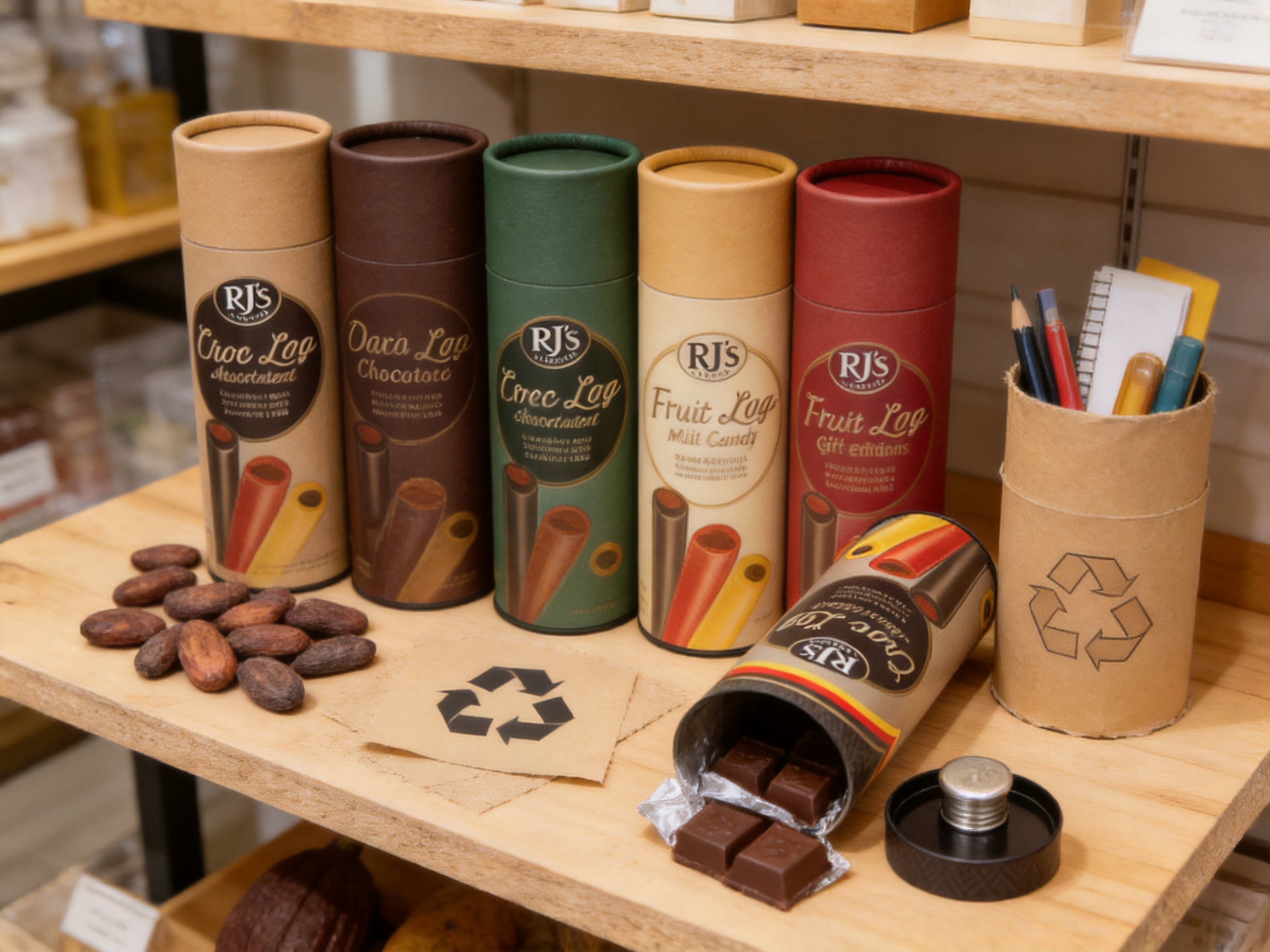
One advantage of custom packaging is the ability to create a coherent product family. A brand may use the same tube size and structure for several flavors while changing the label colors, illustrations, or flavor names. This creates visual consistency while helping consumers distinguish between variants.
The format can also support seasonal packaging, limited editions, collaborations, and gift sets. A single structural platform can be adapted for holiday graphics, anniversary designs, promotional artwork, or regional product variations. This can simplify brand management while preserving the distinctive cylindrical identity.
Comparison with Common Competing Formats
Every packaging format has strengths and limitations. The right choice depends on the product, market, budget, sales channel, and brand strategy. The following comparison explains where a cylindrical paper tube can provide an advantage.
| Packaging format | Typical strengths | Potential limitations compared with a paper tube | Where the cylindrical tube can be stronger |
|---|---|---|---|
| Flexible plastic wrapper | Lightweight, compact, efficient for basic product protection | Limited rigidity and less premium physical presence | Provides a more substantial presentation and added outer protection |
| Folding carton | Efficient printing, easy flat shipment, familiar retail format | Rectangular appearance may be less distinctive; can be vulnerable to crushing | Offers a memorable cylindrical shape and continuous wraparound graphics |
| Plastic canister | Rigid, durable, and available in many shapes | May not support a paper-forward brand identity; material preferences vary by market | Combines rigid form with paper-based construction and strong printability |
| Metal tin | Strong, reusable, and premium-looking | Can be heavier and may involve higher material and forming costs | Can provide a lighter paper body with a tin closure accent |
| Glass jar | Premium appearance and product visibility | Heavy, fragile, and less convenient for transport | Offers a lighter and more impact-tolerant outer package |
| Simple paper bag | Low material use and easy storage | Limited structure and reduced protection for delicate chocolate products | Provides a more stable container and improved gift presentation |
This comparison does not mean that the tube is appropriate for every chocolate product. A flexible wrapper may be preferable for a mass-market single-serving bar, while a metal tin may be selected for a highly collectible product. The strength of the cylindrical paper tube is its balance. It combines a distinctive shape, printable surface, moderate weight, rigid presentation, and customizable construction in one format.
Food Packaging Considerations
Chocolate packaging must be developed with food safety and product protection in mind. The container, label, closure, inner wrap, adhesives, inks, and any coatings should be selected for their intended application. The paper tube is an outer packaging solution, and the complete package may require an inner food-contact layer or sealed primary wrap depending on the chocolate formulation and distribution conditions.
Chocolate can be affected by moisture, oxygen, heat, odors, light, and physical abrasion. The required barrier system depends on the recipe, cocoa content, inclusions, surface decoration, storage period, and sales environment. Products with delicate finishes or fillings may need a stronger primary barrier than solid bars. The tube can then function as the protective and branding-focused secondary package.
Manufacturers and brands should confirm the applicable food packaging requirements in each target market. These may include material declarations, migration testing, ink and adhesive suitability, labeling regulations, traceability procedures, and quality documentation. Packaging should also be evaluated for odor transfer, surface cleanliness, closure performance, and compatibility with the filling process.
A responsible packaging project begins with clear technical communication. Before production, the customer should provide the product dimensions, product weight, primary wrapping method, filling speed, expected shelf life, storage temperature, transportation conditions, artwork requirements, and target market. These details allow the manufacturer to recommend a practical structure instead of relying only on a visual sample.
Manufacturing Expertise Behind the Product
More Than Two Decades in Composite Cans and Paper Cans
Hangzhou Qunle Packaging Co., Ltd. has been engaged in the composite can and paper can industry for over 20 years. This experience is important because paper tube manufacturing involves more than printing a label and forming a cylinder. The production process must coordinate paper selection, winding or forming, adhesive application, dimensional control, label placement, closure matching, finishing, inspection, and packing.
Long-term specialization allows a manufacturer to understand how different paper structures behave during production and use. It also supports more reliable troubleshooting when a project involves unusual dimensions, complicated artwork, special closures, or demanding delivery requirements. Experience across food, daily chemical, and fast-moving consumer goods applications can help the manufacturer identify practical solutions for different market environments.
Participation in the Composite Can and Tube Industry
The company is described as the only member of the international Composite Can and Tube Institute in China’s packaging container industry. Industry participation can support technical awareness, professional exchange, and a better understanding of developments in composite can and tube packaging. For customers, this background is an indication that the supplier is closely connected with the specialized field rather than treating paper tubes as a minor extension of another packaging business.
Food Packaging Qualification Experience
Qunle Packaging was the first enterprise in China to pass the QS certificate for producing food packaging containers, according to the supplied company information. Food packaging qualification experience is relevant to chocolate packaging because it reflects the importance of controlled production, material suitability, hygiene, documentation, and consistent quality.
Certification should always be reviewed according to the specific project and destination market. Nevertheless, a supplier’s history of producing food packaging containers can reduce uncertainty during development. It suggests that food-related requirements have been part of the company’s operating experience for many years.
European High-Speed Production Equipment
In 2015, the company introduced a high-speed composite can production line from Europe. Modern high-speed equipment can improve production consistency, output capacity, and process control when it is correctly operated and maintained. It may also support more efficient handling of repeat orders and larger commercial programs.
Equipment alone does not guarantee quality. The performance of a production line depends on engineering, operator training, maintenance, material control, inspection standards, and process management. However, the investment demonstrates a commitment to industrial-scale manufacturing and continuous improvement. It also provides a stronger foundation for customers who require both customized design and dependable volume production.
Patented Technologies and Product Development
The company has obtained more than 10 patented technologies and is committed to researching and launching high-quality packaging products for the global market. Patented technologies may relate to structural design, manufacturing methods, closure systems, material combinations, or other areas of packaging development. The specific relevance depends on the customer’s project, but a portfolio of patents indicates continued investment in technical innovation.
For a custom chocolate tube, product development may include evaluating the tube diameter, height, wall strength, plug fit, label overlap, printing registration, and interior arrangement. A supplier with research and development experience can help move a concept from a visual idea to a manufacturable package.
Manufacturing Process for a Custom Chocolate Paper Tube
1. Product and Requirement Analysis
The process begins with a review of the chocolate product and the customer’s commercial objectives. The manufacturer needs to understand whether the tube will hold a single bar, multiple pieces, individually wrapped candies, or a confectionery assortment. Product dimensions, weight, shape, fragility, and primary wrapping all influence the tube’s internal design.
The team should also review the intended sales channel. Retail shelves, e-commerce fulfillment, gift shops, promotional events, and subscription services may create different requirements. An online product may need additional outer shipping protection, while a retail item may need strong shelf stability and easy barcode visibility.
2. Structural Development
Once the requirements are understood, the tube structure can be developed. This stage includes selecting the internal diameter, height, wall construction, base design, opening design, and closure type. The reference product uses an internal diameter of 73 millimeters and a height of 170 millimeters, but customized measurements may be considered.
Structural development should account for manufacturing tolerances. A tube must be large enough to accept the wrapped chocolate without damaging it, but not so large that the product moves excessively. The tin plug must match the opening accurately. The base must remain stable when the package is placed upright. The external dimensions should also be compatible with shipping cartons and retail displays.
3. Paper and Label Preparation
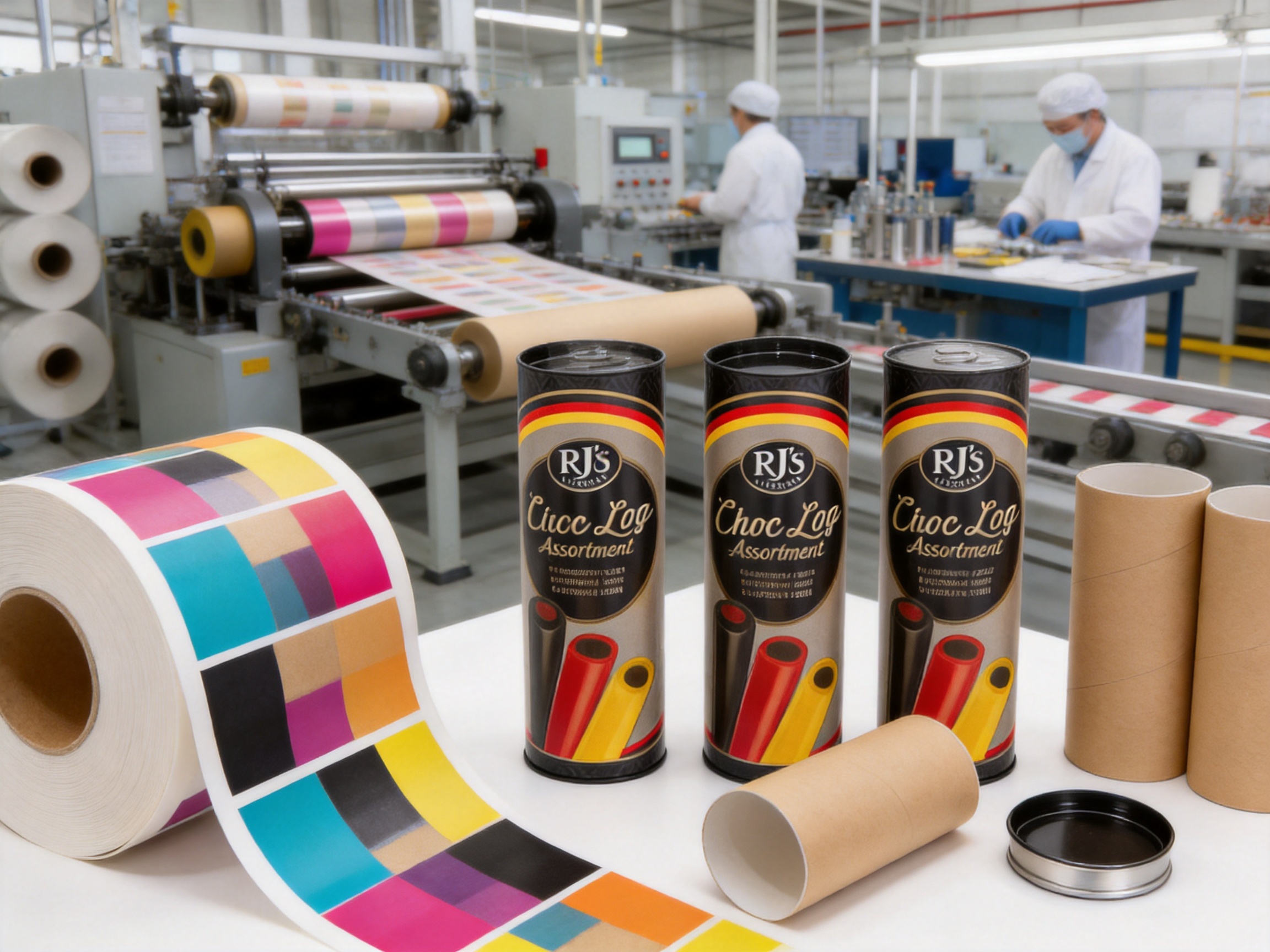
Paper materials are prepared according to the approved structure and appearance. The art paper label is printed with the customer’s artwork, usually using CMYK printing and offset printing as specified for the product. Before mass production, artwork should be checked for color balance, text accuracy, barcode readability, image resolution, seam positioning, and regulatory information.
Because the label wraps around a curved surface, the artwork must be adapted for cylindrical application. Designers should allow for the label seam, avoid placing critical text too close to the edges, and check how straight lines and repeated patterns appear after wrapping. A proof or pre-production sample can help identify issues before the full production run.
4. Tube Forming and Body Assembly
The paper layers are formed into the cylindrical body using a controlled production method. Depending on the design, the body may be assembled from spiral-wound or parallel-wound paper layers, with adhesives used to bond the structure. The selected process influences the tube’s strength, surface quality, dimensional accuracy, and suitability for the intended application.
During forming, key parameters include alignment, adhesive distribution, winding tension, tube diameter, wall thickness, and curing or drying conditions. Consistent control helps prevent loose layers, uneven edges, deformation, or weak seams. The production team must maintain the balance between speed and accuracy, especially when manufacturing large quantities.
5. Label Application and Surface Finishing
After the tube body is formed and prepared, the printed art paper label is applied to the outer surface. Proper label placement is essential to the final appearance. Misalignment can affect the perceived quality of the product, particularly when the artwork contains horizontal bands, centered logos, or repeated patterns.
Surface finishing may be selected to protect the printed design or create a specific tactile effect. Any additional finish should be confirmed for compatibility with the paper, printing process, food packaging environment, and customer expectations. The goal is to create a durable and attractive surface without adding unnecessary complexity or material.
6. Tin Plug Fitting
The tin plug is matched with the tube opening during assembly or final preparation. The fit should be evaluated for appearance, holding force, ease of use, and repeatability. The closure should not cause excessive compression, tearing, or deformation of the paper body.
For products intended to be opened and closed repeatedly, practical use testing is valuable. Samples can be opened and closed several times to examine whether the plug remains secure and whether the tube edge maintains its shape. Transportation testing can also help determine whether vibration or stacking pressure affects the closure.
7. Inspection and Packing
Finished tubes should be inspected according to agreed quality standards. Typical checks may include dimensions, body roundness, label position, printing quality, color consistency, surface cleanliness, plug fit, edge condition, and overall appearance. For food packaging, production hygiene and material traceability are also important.
After inspection, the tubes are packed to prevent damage during storage and transportation. Packaging cartons should be designed to reduce crushing, abrasion, moisture exposure, and excessive movement. The shipping arrangement should also consider warehouse efficiency and the customer’s receiving process.
Quality Control Priorities
Quality control for custom paper tube packaging should cover both visible appearance and functional performance. A package can look attractive in a sample but fail to perform consistently in mass production if the structure, material, or process is not properly controlled.
Dimensional Accuracy
Internal diameter and height must be consistent enough to support efficient filling and product protection. Variations can affect the ease of inserting the chocolate bar, the appearance of the product inside the tube, and the fit of the tin plug. External dimensions also influence carton packing and retail presentation.
Printing and Color Consistency
CMYK printing requires careful management of color reproduction. The approved reference should be used when checking production output. Color may appear different depending on paper surface, ink coverage, lighting, and finishing. Brands with strict color standards should establish an approval process before mass production.
Label Position and Seam Control
The label should be positioned evenly around the tube, with controlled overlap and no visible lifting. The seam should be located according to the approved artwork. Critical information, logos, and decorative features should remain properly aligned.
Closure Performance
The tin plug should be checked for insertion depth, retention, ease of opening, surface condition, and compatibility with the paper body. The closure should create a finished appearance and function reliably throughout normal handling.
Surface and Edge Condition
Customers expect premium packaging to be clean and free from obvious dents, scratches, loose paper fibers, adhesive marks, wrinkles, or printing defects. Tube edges and openings should be inspected because small imperfections in these areas can affect both appearance and closure performance.
Sustainability Benefits and Responsible Use
Environmental performance is increasingly important in chocolate and confectionery packaging. The use of paper-based materials can support a brand’s efforts to reduce reliance on certain plastic-heavy formats and communicate a more natural packaging direction. The product’s all-paper tube body is therefore relevant to businesses seeking paper-forward packaging.
However, sustainability should be evaluated across the complete package. The primary food wrap, label, adhesive, ink, closure, coatings, manufacturing energy, transport, and end-of-life pathway all contribute to the overall environmental profile. A paper tube with a tin plug may contain different material components, and local recycling systems may handle those components separately.
Brands should provide clear disposal guidance based on the actual construction and the regulations of the target market. If the paper body and metal plug can be separated, that may support more straightforward sorting. If the paper includes coatings or bonded materials, recyclability may depend on local facilities and accepted material specifications. Responsible claims should be based on verified construction details rather than broad assumptions.
The tube can nevertheless support several practical sustainability objectives. Paper is widely recognized by consumers as a familiar packaging material. The rigid format may be reused for storage. Its relatively light structure can offer a balance between protection and material efficiency. The package can also be designed for a long service life, reducing the likelihood that it will be discarded immediately after opening.
Effective sustainability also includes avoiding unnecessary overpackaging. The tube should be sized appropriately for the product, with enough protection for distribution but without excessive empty space. Efficient carton packing and responsible material selection can further improve the project’s environmental performance.
Applications Beyond Standard Chocolate Bars
Although the featured product is designed for chocolate and candy bar packaging, the cylindrical format can be adapted to various confectionery and dry food applications. Possible uses include chocolate truffles, pralines, wrapped candies, cookies, wafer products, snack mixes, nuts, tea-based treats, seasonal confectionery, and gift assortments.
The suitability of the tube depends on the product’s dimensions, weight, moisture sensitivity, aroma characteristics, and required barrier protection. Dry products with individual inner wrapping may be particularly suitable. Products with high moisture, oily surfaces, delicate coatings, or strong aroma transfer requirements may need specialized inner packaging and testing.
The same structure can also support promotional products and corporate gifts. A company may use a customized tube for branded chocolate bars at exhibitions, conferences, hospitality events, or seasonal campaigns. The large printable surface provides space for a message, event identity, or collaboration design while maintaining a useful package after the contents are consumed.
Branding Opportunities for Chocolate Manufacturers
Premium Visual Storytelling
A cylindrical package gives brands room to tell a complete story. The label can introduce the origin of the cocoa, the character of the flavor, the craftsmanship of the recipe, or the occasion for which the product was created. Illustrations can wrap around the tube to create an unfolding visual narrative.
Flavor Differentiation
Multiple flavors can be assigned distinct colors while retaining the same structural format. For example, a dark chocolate variant may use a deep and sophisticated palette, while a fruit-filled flavor may use brighter imagery. Consistent typography and tube dimensions help the range look unified, while color and ingredient illustrations support quick identification.
Seasonal and Limited Editions
The package is well suited to limited-edition artwork. Holiday patterns, anniversary graphics, regional motifs, and collaborations can be introduced without changing the fundamental cylindrical structure. This can help brands create collectability and encourage repeat purchases.
Premium Unboxing
Opening a tube can feel different from unfolding a carton. The customer removes the tin plug and discovers the chocolate inside, creating a simple but memorable interaction. The interior can also be considered during the design stage. Product wrapping, inserts, tissue, or printed interior elements may be used where appropriate and technically feasible.
Advantages of Working with an Experienced Factory
Choosing a factory with specialized experience can influence the success of a custom packaging project from the earliest concept stage. A factory that understands paper cans and composite tubes can offer more than basic production. It can help coordinate structural development, artwork preparation, material selection, quality control, and commercial delivery.
Hangzhou Qunle Packaging Co., Ltd. operates from Zhejiang, China, and identifies itself as a factory serving global customers. Its company profile emphasizes more than 20 years in the composite can and paper can industry, partnerships with established companies and brands, food packaging qualification experience, European high-speed production equipment, and more than 10 patented technologies.
The company’s experience across different application categories is also relevant. Food packaging requires attention to hygiene and protection, daily chemical packaging may require resistance to different product conditions, and fast-moving consumer goods demand consistent quality and efficient production. Knowledge gained across these sectors can support flexible problem solving for customized chocolate tube projects.
Long-term customer relationships with companies such as COFCO, STANDERS, DAVIDsTEA, Avalanche Coffee, Whittaker’s, McSteven’s, Nongfu Spring, and Beingmate are included in the supplied company information. These relationships demonstrate experience serving established commercial customers, although each new project should still be evaluated according to its own specifications, testing requirements, and approval procedures.
How to Develop a Successful Custom Tube Project
Define the Product Before the Artwork
Artwork should not be finalized before the structural requirements are understood. The product dimensions, inner wrap, opening method, closure, and filling process should be established first. This prevents late changes that can affect the label size, barcode placement, or visual proportions.
Provide Accurate Technical Information
Customers should provide precise product measurements and clear photos or drawings where possible. Information should include length, width, height, diameter, weight, primary package dimensions, and the number of pieces per tube. If the product changes shape or size during production, that should also be communicated.
Confirm the Intended Market
Packaging laws and disposal systems vary between markets. The label may require different languages, nutritional formats, allergen statements, importer information, or recycling guidance. The manufacturer can prepare the physical package, but the brand remains responsible for confirming the legal content required in each destination.
Approve a Pre-Production Sample
A sample allows the customer to evaluate the physical structure, artwork placement, color appearance, closure fit, and overall consumer experience. It is easier and less expensive to correct problems during sampling than after mass production. The sample should be reviewed not only visually but also through practical handling and filling simulations.
Establish Quality Standards in Writing
Important criteria should be documented before production. These may include acceptable dimensional tolerances, color references, label alignment, plug fit, surface quality, packing method, inspection procedure, and sampling level. Clear standards reduce misunderstandings and create a shared basis for quality evaluation.
Plan Lead Times and Logistics
Custom packaging requires time for design preparation, structural development, sampling, approval, material procurement, production, inspection, and shipment. Brands should plan early, especially for seasonal chocolate products or campaigns with fixed launch dates. Shipping cartons and warehouse conditions should be considered at the beginning rather than after production is complete.
Commercial Benefits for Different Types of Brands
Established Chocolate Brands
Established brands can use cylindrical tubes to create premium sub-ranges, gift editions, seasonal products, or special collaborations. The format can add variety to an existing portfolio without abandoning established brand elements. A consistent tube structure can also support a recognizable series across several flavors.
Artisanal and Craft Producers
Small and craft chocolate producers often need packaging that communicates individuality. A custom label with illustrations, origin information, or hand-crafted visual language can help a tube reflect the character of the product. The package can make a limited production run appear intentional and carefully developed.
Private-Label Retailers
Retailers developing private-label chocolate products can use the cylinder as a distinctive store-brand signature. Different sizes or flavor labels can be organized under one structural platform. The format may help a private label stand apart from conventional supermarket packaging.
Corporate and Promotional Buyers
Companies purchasing branded confectionery for events or gifts can use the printable surface for logos, messages, campaign graphics, and event dates. The tube’s reusable potential may increase its value compared with disposable promotional wrappers.
Limitations and Points Requiring Attention
A balanced packaging evaluation should recognize that cylindrical paper tube packaging is not without limitations. The round shape may require more careful carton packing than rectangular boxes. It may also use more material than a minimal flexible wrapper. The tube is not necessarily suitable for direct food contact unless the complete structure has been specifically designed and approved for that purpose.
The tin plug introduces an additional material component and may require separate end-of-life handling. If a fully paper package is required, another closure concept may need to be considered. The cylindrical format can also create challenges for certain automated filling lines, particularly if the equipment is designed exclusively for cartons or pouches.
These considerations do not reduce the value of the product; they show why customization and technical consultation are important. A qualified supplier should assess the product, filling method, market, and distribution conditions before confirming the final structure. Proper planning can preserve the advantages of the tube while addressing operational requirements.
Q&A: Custom Cylindrical Paper Tube Packaging
What products can be packed in this tube?
The featured design is intended for chocolate bars and candy bars. Depending on the final material structure and inner protection, it may also be adapted for wrapped confectionery, cookies, truffles, nuts, snacks, and other dry products. Each application should be reviewed according to product dimensions, moisture sensitivity, aroma, weight, and shelf-life requirements.
What is the reference size?
The listed reference size is an internal diameter of 73 millimeters and a height of 170 millimeters. This is a starting specification rather than a universal size. Custom dimensions should be developed according to the actual product and filling requirements.
Is the packaging made from paper?
The product is specified as an all-paper container with an art paper label. It also includes a tin plug closure. The complete package may require an inner food wrap or liner depending on the chocolate product and the required barrier performance.
Can the artwork be customized?
Yes. The package is designed for custom artwork. CMYK printing and offset printing can be used for brand graphics, product information, illustrations, flavor identification, and promotional content. Artwork should be prepared according to the approved cylindrical template.
Is the tin plug reusable?
The tin plug is designed as a closure and may support repeated opening and closing when the fit and product design are suitable. Reuse performance should be confirmed through practical testing because the final result depends on the plug dimensions, tube construction, and handling conditions.
Does the tube protect chocolate from heat and moisture?
The paper tube provides an outer structural layer, but it should not be assumed to provide complete heat or moisture protection by itself. Chocolate normally requires a suitable primary wrap or inner barrier. The correct protection system depends on the recipe, storage conditions, distribution environment, and required shelf life.
Yes. The cylindrical shape, rigid presentation, customizable graphics, and tin plug make it suitable for premium products, seasonal releases, gift assortments, and corporate confectionery programs. Finishing, color selection, label design, and inner presentation can be coordinated to create the desired market position.
What printing method is specified?
The product information specifies CMYK printing and offset printing for surface handling. The final printing process and any additional finishing should be confirmed according to the artwork, material, order quantity, and required appearance.
What should be provided when requesting a quotation?
A quotation request should include the product dimensions, desired tube size, quantity, artwork status, material expectations, closure requirements, inner wrapping method, destination market, delivery schedule, and any food packaging documentation needed. Photos or technical drawings of the chocolate product can also help the manufacturer recommend the correct structure.
Why choose a specialized paper tube manufacturer?
A specialized manufacturer understands the interaction between paper materials, tube forming, printing, labeling, closures, and food packaging requirements. The supplier can help identify structural problems early, coordinate sampling, and maintain consistency during volume production. Experience is particularly valuable for projects requiring a distinctive shape or custom closure.
Can one tube design support multiple flavors?
Yes. A common tube structure can be used for several flavors, with different artwork, colors, illustrations, or flavor names. This can create a unified product family while allowing consumers to distinguish between varieties.
Is cylindrical packaging suitable for e-commerce?
It can be suitable for e-commerce when the tube is packed in an appropriate shipping carton or protective mailer. The package’s rigid body can provide useful outer protection, but the full shipping system should be tested for vibration, impact, compression, and movement during delivery.
Can the tube be reused after the chocolate is finished?
The rigid cylindrical structure may be reused for small household items, stationery, crafts, accessories, or storage. Reuse depends on the consumer and the final package condition. Disposal and recycling instructions should still be provided according to the actual material construction and local systems.
Conclusion
Custom eco-friendly cylindrical paper tube packaging with a tin plug provides chocolate and candy brands with a distinctive alternative to ordinary wrappers and cartons. Its all-paper body, art paper label, CMYK printing, offset surface treatment, and customizable dimensions create a flexible platform for product protection and brand presentation. The reference size of 73 millimeters internal diameter by 170 millimeters high demonstrates the type of compact format that can be developed for chocolate bar packaging, while custom sizing allows the structure to be adapted to other products.
The tube’s strongest competitive advantage is its balance of visual impact and practical function. It offers a recognizable cylindrical silhouette, a large wraparound branding area, a firm outer structure, a premium opening experience, and the possibility of reuse. Compared with flexible wrappers, it provides a more substantial presentation. Compared with conventional cartons, it creates a more distinctive shape. Compared with heavier rigid packages, it can offer a paper-forward and potentially lighter solution.
The manufacturing capabilities behind the package are equally important. Hangzhou Qunle Packaging Co., Ltd. brings more than 20 years of experience in composite cans and paper cans, participation in the specialized tube packaging industry, food packaging qualification experience, modern European high-speed equipment, long-term cooperation with recognized brands, and more than 10 patented technologies. These strengths support the development of packaging that is not only attractive in concept but also practical to produce at commercial scale.
For the best result, brands should approach the project as a complete packaging system. Product dimensions, inner wrapping, barrier requirements, closure fit, artwork, filling operations, shipping conditions, food packaging regulations, and end-of-life considerations should all be addressed before mass production. With careful structural design, sampling, testing, and quality control, a cylindrical paper tube can help a chocolate product stand out while delivering a thoughtful combination of protection, customization, and responsible material direction.
References
1. Supplied product specification for custom cylindrical paper tube packaging with tin plug for chocolate and candy bars.
2. Supplied company profile for Hangzhou Qunle Packaging Co., Ltd.
3. Composite Can and Tube Institute, general industry information on composite cans and paper tubes.
4. General food packaging quality and material compatibility principles for confectionery products.
5. General packaging design and transport protection principles for chocolate and dry food products.
